Feasibility of U5MR Estimation via Serial MIS Data
Role: Senior Research Fellow | Postdoctoral Scientific Collaborator
Organization: Swiss TPH | PNG Institute of Medical Research (PNGIMR)
Domain: Demography, Maternal & Child Health, Data Validation
1 The Challenge
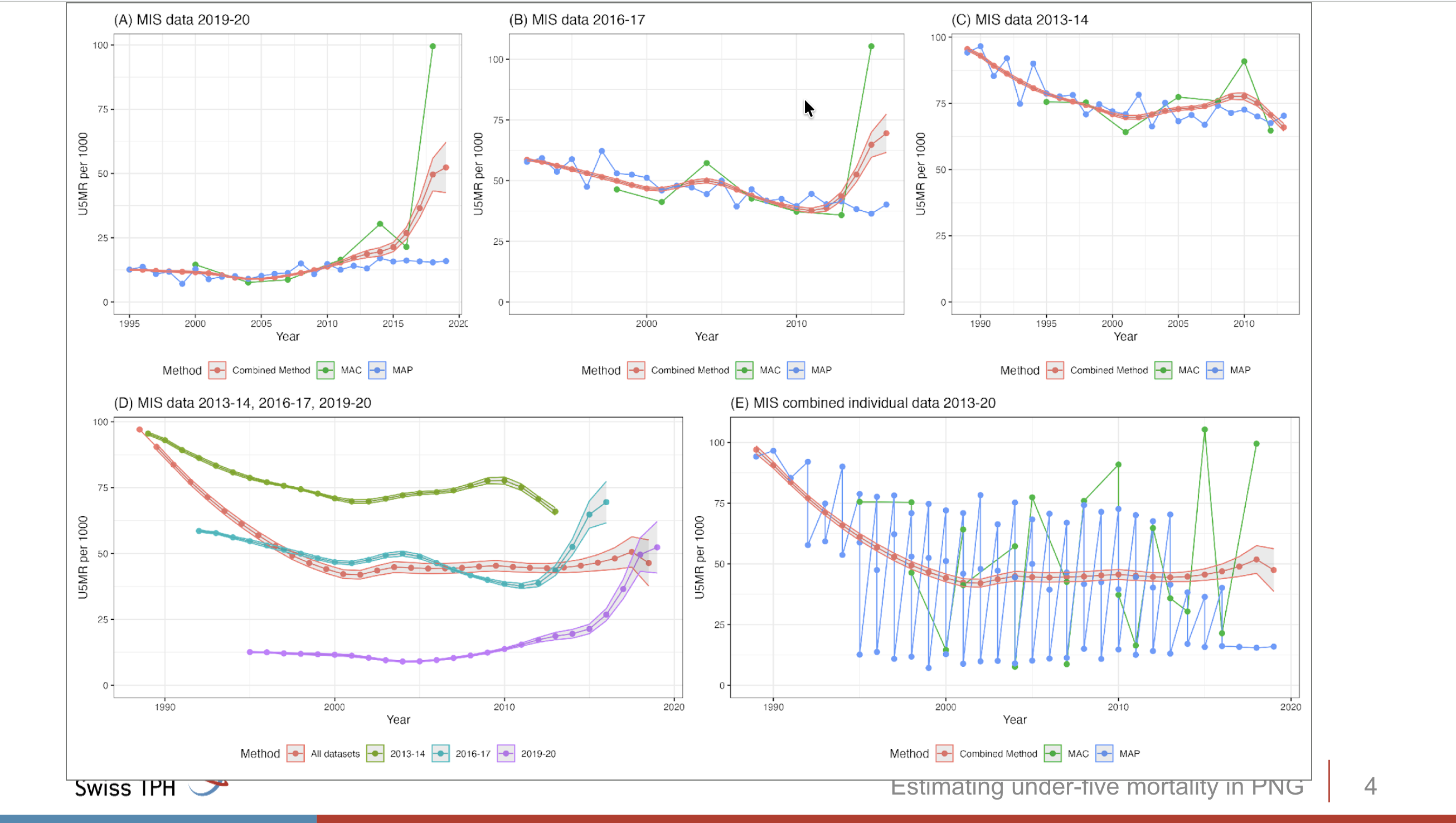
Estimating the Under-Five Mortality Rate (U5MR) is critical for evaluating health interventions. In resource-limited settings like Papua New Guinea, researchers often attempt to use Malaria Indicator Surveys (MIS) as a proxy for Demographic and Health Surveys (DHS). The challenge was to determine if serial MIS data (2013–2020) could provide reliable, sub-national U5MR estimates using indirect estimation methods.
2 The Solution: A Methodological Deep-Dive
I applied advanced demographic modeling to three consecutive MIS datasets to test the feasibility of U5MR tracking. Rather than accepting the outputs at face value, I conducted a rigorous validation of the internal and external consistency of the results.
- Comparative Modeling: Applied both Maternal Age Cohort-derived (MAC) and Maternal Age Period-derived (MAP) variants of the Rajaratnam et al. (2010) method.
- Uncertainty Quantification: Executed a 1,000-iteration bootstrap simulation combined with LOESS regression to generate point estimates and 95% confidence intervals, adjusting standard errors to account for design-driven deflation.
- Data Quality Audit: Identified significant discrepancies between the three survey waves, specifically noting “implausible” outcomes, including negative mortality values at the provincial level.
3 Technical Deep-Dive
- Indirect Estimation: Utilized regression-based models where \(U_{ij}\) (country random effects) and parity ratios were used to predict mortality up to 25 years prior to the survey.
- R Pacakge: Given the package’s status in the CRAN Archive, I managed version-specific dependencies to ensure the reproducibility of the maternal age cohort (MAC) and maternal age period (MAP) models
- Statistical Refinement: Corrected standard errors by a factor of 4.0 to account for artificial deflation in the simulation.
- Tech Stack:
R,tidyverse,loess,boot(Bootstrapping),ggplot2.
4 Critical Findings & Lessons
This project served as a vital “proof-of-concept” that revealed the limitations of using MIS data for mortality surveillance in this context: 1. Unreliability of Small Samples: Negative U5MR values at the provincial level highlighted the sensitivity of indirect methods to small sample sizes and potential maternal survival bias. 2. Survey Heterogeneity: Large gaps between estimates from different survey years suggested possible variations in interview methods or data quality between 2013 and 2019. 3. Strategic Recommendation: Provided evidence that while MIS data is excellent for malaria indicators, it may require significant methodological adjustment or larger sample sizes to be a viable substitute for full DHS mortality modules.